
Uncle Pushed Grandma Through Glass, Called Her Useless, Then Her Secret Trust Ended His Career


The quiet of Grandma Eleanor’s house felt heavier now. The glass partition was gone, repaired with a temporary sheet of plywood, but the memory of the shattering sound lingered like a phantom echo in my ears. I found Eleanor in her study, a room usually buzzing with her vibrant energy. Now, she just sat.
Her gaze was fixed on a half-finished crossword puzzle, the pen lying motionless beside it. She hadn’t touched it in days.
“Grandma?” I asked, my voice softer than I intended.
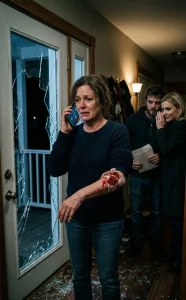
She didn’t stir. Her arm, where the glass had cut her, was neatly bandaged, but beneath the sterile white, I imagined the angry red line.
“I found out about The Spark Foundry,” I continued, trying to break through her silence. “Robert and Brenda, they want to sell the land. Liquidate everything.”
Her eyes flickered, barely. A shallow breath escaped her.
“They sabotaged the grants, too,” I pressed, feeling a desperate urgency. “All those applications, they weren’t just rejected. They were *misfiled*. Intentionally.”
She finally looked at me, but her eyes held a hollow, distant quality I’d never seen before. It was as if a part of her had simply retreated, leaving an empty space behind.
“It doesn’t matter, Maya,” she whispered, her voice a dry rustle.
My stomach clenched. “Of course it matters! It’s your life’s work. Your legacy!”
She shook her head slowly, a single tear tracking a path through the fine lines around her eyes. “Some things… some things break, Maya. And they don’t mend.”
I knelt beside her chair, trying to meet her gaze, to pull her back. “We can fight them. We have proof.”
But her eyes drifted back to the untouched crossword puzzle, to the blank spaces where words should have been. Her silence felt like a heavy shroud, wrapping around us both. It was a silence born not of shock, but of profound defeat. I felt utterly helpless. How could I fight for her if she wouldn’t even fight for herself?
Hours later, the house remained quiet, but the air felt charged, expectant. I couldn’t settle. The thought of Robert’s ruthlessness gnawed at me. I walked through the empty hallways, my footsteps hushed. As I passed Robert’s temporary office, the door was slightly ajar.
A low, urgent murmur emanated from within.
I froze.
It was Robert’s voice, hushed but sharp with irritation. I leaned closer, my heart beginning to pound against my ribs.
“No, I don’t care what Dr. Finch says about her being ‘cooperative’,” Robert snapped into the phone. “Cooperative doesn’t mean *competent*. We need her declared incapacitated. Soon.”
My breath hitched. Incapacitated. The word hung in the air, cold and sharp.
“I’ve reviewed the first draft of the petition,” he continued, his voice dropping even lower. “It needs to emphasize her erratic behavior, her ‘withdrawal from reality’ after the… incident. Downplay the injuries, obviously. Frame it as mental fragility.”
My blood ran cold. He wasn’t just trying to get her to sign over assets. He was trying to erase her mind, to strip away her autonomy completely. The idea that he would use Eleanor’s very sadness, her retreat from the trauma, as ammunition against her, felt like a fresh, deeper betrayal.
“The board meeting is set for next month,” Robert said, a triumphant edge creeping into his tone. “By then, we’ll have all the affidavits in place. A competency hearing is a formality once we have the doctors on board and the legal framework solid.”
He paced a few steps, his voice muffled for a moment, then clearer. “This incapacitation order grants me full, uncontested control. No more trust. No more meddling from her. And definitely no more Spark Foundry. It goes to market immediately after the order is finalized. Understood?”
I pressed my hand against my mouth to stifle a gasp. My grandmother’s quietness, her profound grief, wasn’t just a personal tragedy. It was a weapon Robert intended to wield against her, to justify tearing down everything she had ever built. He was using her pain as a convenient narrative for her supposed ‘mental decline,’ a twisted justification for his greed.
I backed away slowly, silently, my mind reeling. The fear was a physical ache in my chest. He wasn’t just after The Spark Foundry; he was after Eleanor herself, her very right to exist as a thinking, deciding person. If he succeeded, there would be no fighting, no proof, no legacy. Eleanor would be gone, even while she was still here.
I felt utterly, terrifyingly alone. Who could I turn to, when the enemy wasn’t just stealing land, but attempting to steal a mind? The legal system, which I had naively believed offered protection, was being twisted into an instrument of profound cruelty. I had never felt such a profound sense of powerlessness. This wasn’t just about money anymore; it was about stripping away a person’s dignity and existence.
My mind raced through names: family friends, past colleagues of Eleanor’s. But Robert and Brenda had meticulously isolated Eleanor, portraying her as senile to anyone who might listen. Any attempt I made to speak out would likely be dismissed as the ramblings of a naive college freshman, manipulated by an unstable old woman. The thought was a bitter pill.
I retreated to my room, the overheard words echoing relentlessly. “Incapacitated.” “Mental fragility.” The injustice burned hotter than ever. Eleanor, who had built an empire, who had conceived of innovative technologies that changed industries, was now being painted as a doddering old woman, easily manipulated, losing her grip. It was a cruel irony.
I looked at my laptop, its screen a blank slate. What could an eighteen-year-old computer science freshman do against a corporate lawyer and a CEO determined to ruin his own mother? The scale of the battle seemed insurmountable. Yet, I couldn’t simply do nothing. The image of Eleanor’s distant eyes, and Robert’s smug, calculating voice, fueled a quiet fire of resolve within me. I just didn’t know where to start.
I thought about the blueprints for The Spark Foundry, still tucked away in my bag. They were more than just architectural plans; they were the physical manifestation of Eleanor’s dream, a place where innovation and community intertwined. Robert was threatening not just a building, but a philosophy, a way of life that Eleanor had championed for decades. And now, he was targeting Eleanor herself, the very heart of that vision.
The cold dread lingered, but beneath it, a tiny, defiant spark began to glow. I knew I couldn’t go to the police; this was a civil matter, a family dispute, carefully engineered by Robert to seem legitimate. I couldn’t rely on other family members; they either sided with Robert or were too intimidated to speak up. The only path forward, I realized, was to outmaneuver Robert within the system he was so expertly corrupting. But how? The question echoed in the quiet room, unanswered and terrifying. I had to find a way.
The night outside deepened, and I remained sitting, staring at the wall, running through every legal term I’d heard, every corporate maneuver Robert had ever boasted about. This wasn’t just helping my grandma anymore. This was a war for her very identity, for her right to be seen as a person of sound mind, and for everything she held dear. And I, her inexperienced granddaughter, was now on the front lines, armed with nothing but desperate loyalty and a burning sense of injustice. The silence in the house no longer felt like mourning; it felt like a silent scream.
More Stories




+ There are no comments
Add yours