
In 1944 Boston, a Bankrupt War-Factory Widow Fighting for Her $5,000 Back-Pay Outsmarts a Corrupt Requisition Officer Who Planted a Stolen Diamond Ring to Frame Her for Treason.



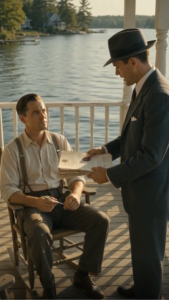
The courtroom was electric. Kincaid, utterly broken, sagged in his chair, his legal team whispering frantically around him. Leo sat beside me, his small hand still holding mine, a silent anchor.
Assistant U.S. Attorney Hennessey stepped forward for his closing statement. His voice, now resonating with conviction, filled the room.
“Your Honor, ladies and gentlemen of the jury,” he began, his gaze sweeping across the room. “We have heard, directly from Mr. Kincaid’s own recorded voice, his malicious intent. We have seen, in meticulous detail within this hidden ledger, his systematic pattern of fraud against the very families sacrificing for this nation.”
He held up the wire recorder. “This device, a silent witness, captured Kincaid’s plot. It was found, not by chance, but by the very person he sought to destroy, Mrs. Evelyn Driscoll, who bravely stood against his schemes.”
Then he presented the ledger. “And this ledger, discovered by Mrs. Driscoll’s observant son, Leo, reveals a far wider, more insidious conspiracy. A conspiracy to siphon funds intended for our war effort, funds belonging to those left vulnerable by the ultimate sacrifice.”
Hennessey’s voice rose, powerful and unwavering. “This is not merely a case of attempted theft or false reporting. This is a betrayal of public trust. A betrayal of our nation’s wartime values. Harlan Kincaid abused his position, exploited the system, and targeted the weakest among us for his own illicit gain. We ask this court to deliver a verdict that reflects the gravity of these crimes—”
The heavy oak doors at the back of the courtroom suddenly burst open.
Four men in crisp, dark uniforms, their faces unreadable, marched in with swift, purposeful strides. They carried official-looking cases and bore the insignia of federal military intelligence. The hushed courtroom erupted into a ripple of shocked whispers.
One of the officers, a man with a severe expression and close-cropped hair, held up a document. “Your Honor,” he announced, his voice cutting through the murmurs, “we have a priority warrant from the Office of Military Intelligence.”
He approached the judge’s bench. The judge, startled, leaned forward to examine the papers. Her expression, usually impassive, shifted to one of surprise, then immediate deference.
“This court is hereby ordered to immediately transfer jurisdiction,” the officer continued, his voice echoing in the sudden silence. “All evidence pertaining to Harlan Kincaid, including the wire recording and the ledger, is to be sealed and delivered into federal custody.”
He pointed directly at Kincaid. “Harlan Kincaid is to be remanded into our custody, effective immediately.”
Kincaid, who had been listening with a mixture of confusion and fear, suddenly stood, his eyes wide. His lawyers tried to intervene, but the military intelligence officers were already moving, two of them flanking Kincaid.
“On what grounds?” Kincaid’s lead attorney spluttered, reaching for his client.
“Wartime national security,” the officer replied, his voice devoid of emotion. “These matters relate to a broader investigation. This court’s proceedings are hereby adjourned, pending federal review.”
The confrontation, the climax I had braced myself for, was abruptly cut short. Hennessey, mid-sentence in his closing arguments, stood frozen, his mouth slightly open. The verdict I had so desperately sought, the final, official pronouncement of Kincaid’s guilt, would not be rendered here.
Instead, Kincaid, looking utterly bewildered and terrified, was escorted directly out of the courtroom by the federal agents, his frantic whispers to his lawyers ignored. The gavel didn’t fall. The trial simply ceased, the larger forces of the war effort sweeping in to take control.
My immediate legal nightmare was over, in a strange, unexpected way. But the feeling of a larger, unseen network, still out there, still operating, settled over me like a cold shroud.
More Stories












+ There are no comments
Add yours