
Her CEO Stepfather's Dark Past Was Exposed When My Ten-Year-Old Daughter Became Pregnant


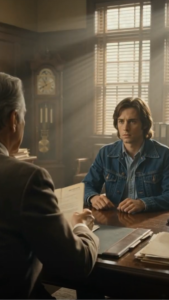
The time had come to meet Julian Vance, the investigative journalist. I arranged for us to gather in Detective Cruz’s office, a neutral and secure space. Leo joined us, his face still bearing the strain of Arthur’s smear campaign, but his eyes now alight with a fierce determination.
Vance was precisely as I had imagined: sharp, incisive, with an air of quiet authority. He sat, listening intently, as I laid out our case. I presented Brenda’s anonymous memo, letting the scanned page speak for itself. I detailed the historical context of the “Morality & Public Trust” clause, explaining its origins in the 1995 public sector grant. Leo then added his perspective, sharing his fragmented memories of Arthur’s early manipulative behavior at FinchTech and the specific “odd NDA” from 1998.
Cruz then stepped in, her voice calm and authoritative, outlining the chilling patterns she had uncovered in her cold case files: Maria Sanchez, Sarah Jenkins, Chloe Davison. She meticulously connected the dots, illustrating how these young, vulnerable women, all former FinchTech employees, had disappeared or met suspicious ends, always followed by corporate settlements and strict NDAs. The collective weight of these stories, juxtaposed with the clause and the memo, created a devastating picture of systemic abuse and cover-up.
Vance listened, occasionally scribbling notes, his expression unreadable. When we finished, a long silence filled the room. Then, he looked up, his gaze sweeping over each of us. “This is a profound story,” he said, his voice quiet.
“It’s not just about a CEO, but about the insidious ways power can corrupt, and how corporate structures can enable abuse.”
He leaned forward, placing his pen on the table. “My angle,” he explained, “will focus on Arthur’s systematic abuse of power and how FinchTech enabled it by ignoring its own historical governance clauses. Lily’s story, anonymized for her protection, will serve as a powerful human anchor, illustrating the devastating personal cost of Arthur’s corporate hypocrisy.” He stressed that he wouldn’t turn it into a sensationalist “sex scandal” but rather a deeply reported piece on corporate malfeasance and a breach of public trust.
The relief that washed over me was immense. Vance understood the nuances, the deeper implications beyond the immediate tragedy. He understood that this wasn’t just about a single act, but a pattern of behavior allowed to flourish under the guise of corporate success. The petty cruelty of Arthur’s actions, his casual disregard for ethical conduct, would finally be exposed in its full, systemic dimension.
Then, Vance delivered a surprise of his own. “I actually have another undisclosed source,” he revealed, his eyes glinting.
“A former FinchTech board member from the nineties. He’s old now, retired, and has a conscience. He’s willing to confirm that Arthur actively worked to downplay the clause’s significance during its implementation phase. He told me Arthur framed it as a ‘necessary bureaucratic hoop’ for public funds, while privately assuring the board it was ‘functionally negligible’ and would be ‘managed internally.'”
My breath caught. This was the final, devastating piece of the puzzle. Not only had Arthur known about the clause’s power, not only had he actively worked to hide it, but he had done so from the very beginning, manipulating his own board. This wasn’t just an oversight; it was a deliberate, long-term strategy of deception. The specific detail of Arthur framing it as a “bureaucratic hoop” underscored his callous disregard for genuine ethical compliance.
“This is big, Julian,” Leo said, his voice filled with admiration.
“This ties it all together.”
Vance nodded. “It gives the story an undeniable weight. It’s not just an accusation; it’s a meticulously documented history of corporate malfeasance, with real human cost. It’s exactly what ‘The Ledger’ is known for.”
We spent another hour outlining the structure of the article, the evidence, and the potential impact. Vance stressed the need for precision, for unimpeachable sourcing, to withstand Arthur’s inevitable counterattack. He assured us that Lily’s identity would be protected at all costs, her story woven in carefully, anonymously, to illustrate the human impact without exploiting her.
Leaving Cruz’s office, I felt a strange mix of fear and exhilaration. We had done it. We had forged a weapon of truth, piece by painful piece. Arthur Finch, the man who had built an empire on lies, was about to face the reckoning he so desperately tried to avoid. The hum of the impending storm was growing louder, and for the first time, I felt a sense of controlled anticipation.
More Stories









+ There are no comments
Add yours