
In October 1867, a young woman arrived at my Leavenworth infirmary holding a handwritten marriage proposal from a brain-injured Civil War veteran.
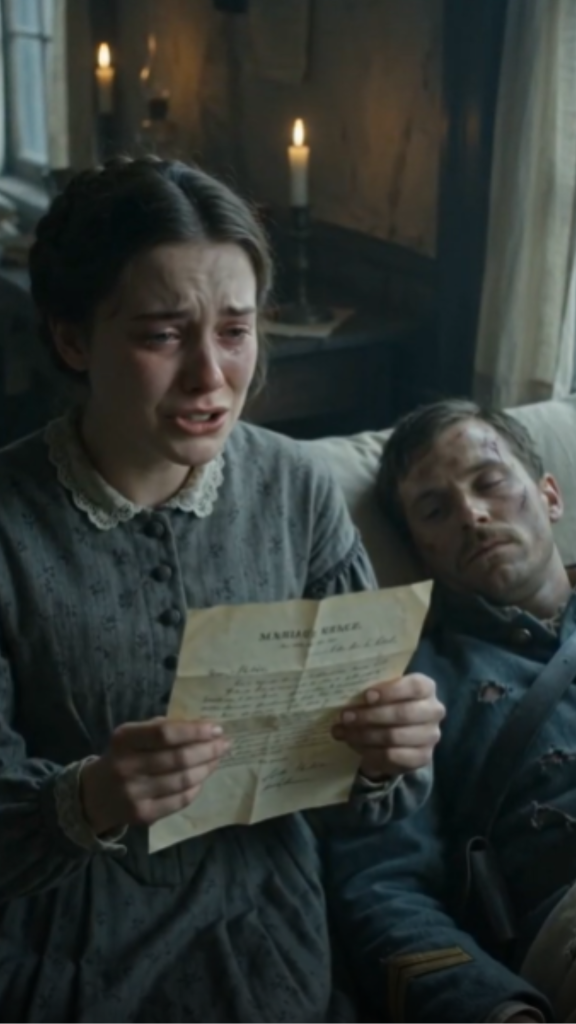


I carried Martha Gable’s precious letter over to my consultation desk. The oil lamp cast a warm, steady glow, but my gut churned with a cold dread. Silas Crain’s earlier threats still echoed in the silent infirmary.
I pulled out my best magnifying glass, the one I used for shrapnel fragments. The paper felt thin and worn beneath my fingers, the ink faded in places.
I leaned closer, tracing the looping script of the marriage proposal Thomas supposedly wrote. The letter promised a future Thomas couldn’t even remember.
Then I saw it. The ink.
It wasn’t ordinary ink, not like the faded sepia I used in my ledgers. This ink was a deep, almost luminous blue. A very specific shade.
I pulled out my own worn ledger from 1865, a record of military supplies requisitioned for this very infirmary. The entries were made with standard black gall ink. No match.
But then a memory stirred. I had seen that blue before.
“Martha,” I said, my voice barely above a whisper. “Where did this letter come from, exactly?”
Martha shifted, her hands twisting the hem of her simple dress. “It arrived through the post, sir. To my home in Ohio. My brother, Caleb, he made sure of it.”
“Your brother?” I pressed. “He served with Thomas?”
“Yes, sir. In the Fourth Ohio Light Artillery,” she confirmed, her gaze dropping to the floor. “He was with Thomas at Peachtree Creek, I believe. They were close.”
“And the color of the ink,” I mused, more to myself than to her. “This blue… it’s peculiar.”
I remembered the quartermaster’s requisitions from late 1864, early 1865. Those particular forms, the ones Silas Crain’s unit handled, often used a distinctive blue ink, a military standard issue for depot ledgers and official correspondence.
It was cheap, plentiful, and a dead giveaway.
“Caleb… he died of camp fever in late ’65, Doctor,” Martha offered, her voice thick with sorrow. “In the Georgia field hospital.”
“The same field hospital where Thomas was brought in,” I finished, a grim knot tightening in my chest. The timing. The ink. It was too precise.
This wasn’t just a letter. It was a paper trail, routed through the very system Silas Crain had commanded. A very distinct, military blue.
The color wasn’t just unusual; it was a signature. A signature belonging not to Thomas, but to the quartermaster’s office. Silas Crain’s office.
I looked at Martha, her face pale in the lamplight. She believed Thomas wrote this. She truly did.
“Martha,” I said, my voice carefully neutral. “Did your brother, Caleb, ever mention Sergeant Crain? Silas Crain, the quartermaster?”
She hesitated, her brow furrowing. “I… I think so, sir. Caleb said Mr. Crain was a ‘stickler for forms.’ He handled all the mail for their battery, after a certain point. Said he was very particular about what went in and out.”
Particular enough to use his own quartermaster’s ink for a personal letter? Or particular enough to intercept one?
The blue ink suddenly felt less like a romantic detail and more like a warning.
More Stories











+ There are no comments
Add yours