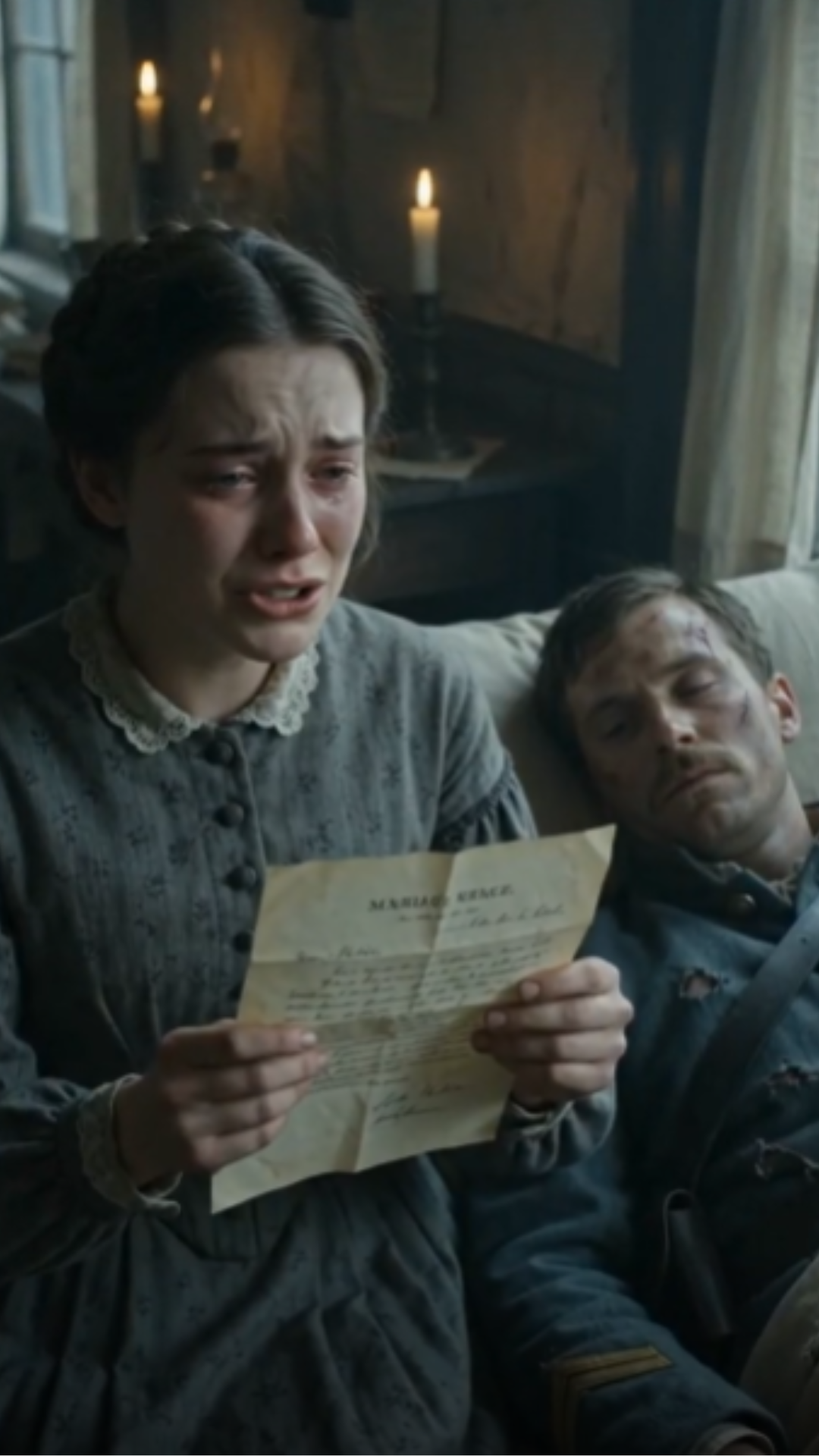
In October 1867, a young woman arrived at my Leavenworth infirmary holding a handwritten marriage proposal from a brain-injured Civil War veteran.


The presence of George and Eli Finch turned my infirmary into a contentious boarding house. Their loud conversations about Thomas’s “estate” and “rights” bounced off the walls, making my other patients uneasy. I needed a counter-argument to Silas’s claims, something undeniable.
That afternoon, needing a moment of respite and a clear head, I walked down to the Leavenworth livery stable. The smell of hay and horseflesh always brought a measure of calm.
A man was tending to a sturdy bay mare, rubbing her down with practiced ease. He had a weathered face and hands, his clothes practical but well-kept. A small, sturdy saddlebag lay beside his feet.
“Good afternoon,” I offered, nodding to him. “Fine animal you have there.”
He looked up, a friendly glint in his eye. “She’s a good worker, this one. Just finished a long stretch from Topeka, delivering some telegraph repair orders.”
“Topeka, you say?” I replied. “You’re a courier, then?”
“Jedidiah Ross,” he said, offering a hand. His grip was firm. “And yes, Doctor, a courier of all sorts. Mostly government dispatches and official records, these days. Sometimes old military logs, even.”
My heart gave a sudden lurch. “Military logs?” I repeated, trying to keep my voice even.
“Indeed,” Jedidiah said, patting his saddlebag. “I’m carrying a stack of them right now. Field hospital records from the Georgia campaign, 1863. Supposed to go into the state archives. Dry stuff, mostly. Triage reports, supply requisitions, daily counts of the wounded.”
“From 1863, you say?” I pressed, a frantic hope sparking within me. “Could I… could I possibly take a look? I’m Dr. Josiah Danforth, by the way. This is my infirmary. I was a Union surgeon myself.”
Jedidiah’s eyes widened slightly in recognition. “Dr. Danforth, a pleasure. Of course, sir. Always glad to help a fellow veteran. These records are vital, after all.”
He unbuckled his saddlebag and carefully pulled out a thick, leather-bound book. The cover was worn smooth, the pages yellowed with age. It smelled of old paper and dust.
“This is the surgical triage ledger from the field hospital at Chickamauga, and then Atlanta,” Jedidiah explained. “Covers August through December 1863.”
My hands trembled slightly as I took the ledger. I flipped through the pages, my eyes scanning the neat, meticulous entries. Date, soldier’s name, regiment, injury, treatment, disposition.
I remembered Silas Crain’s claim: that Thomas Finch owed him $1,200 from a gambling note signed in Nashville in September 1863.
My fingers flew to the entries for late September 1863. And then I found it.
“Finch, Thomas, Sergeant,” the entry read. “4th Ohio Light Artillery.”
The date: September 28, 1863. The same exact date Silas claimed his gambling debt originated.
“Injury: Severe head trauma, shrapnel to temporal lobe. Trepanning surgery performed.”
“Condition: Non-responsive, deep coma.”
“Disposition: Transferred to convalescent ward, September 29, 1863.”
Thomas Finch had been lying unconscious, his skull freshly opened by a surgeon’s trepan, hundreds of miles from Nashville, on the very day Silas Crain claimed he signed a gambling note.
A wave of relief, so potent it almost buckled my knees, washed over me. This was it. This was the irrefutable evidence. Not just against Silas, but against the very idea that Thomas could have consented to anything, let alone a debt, at that time.
Jedidiah Ross, standing patiently by his horse, was oblivious to the earthquake he had just unleashed in my world.
“Remarkable records, aren’t they, Doctor?” he said.
“More remarkable than you know, Mr. Ross,” I replied, carefully closing the ledger. “More remarkable than you know.”
The ledger was a heavy weight in my hands, but it felt like pure gold.
More Stories









+ There are no comments
Add yours