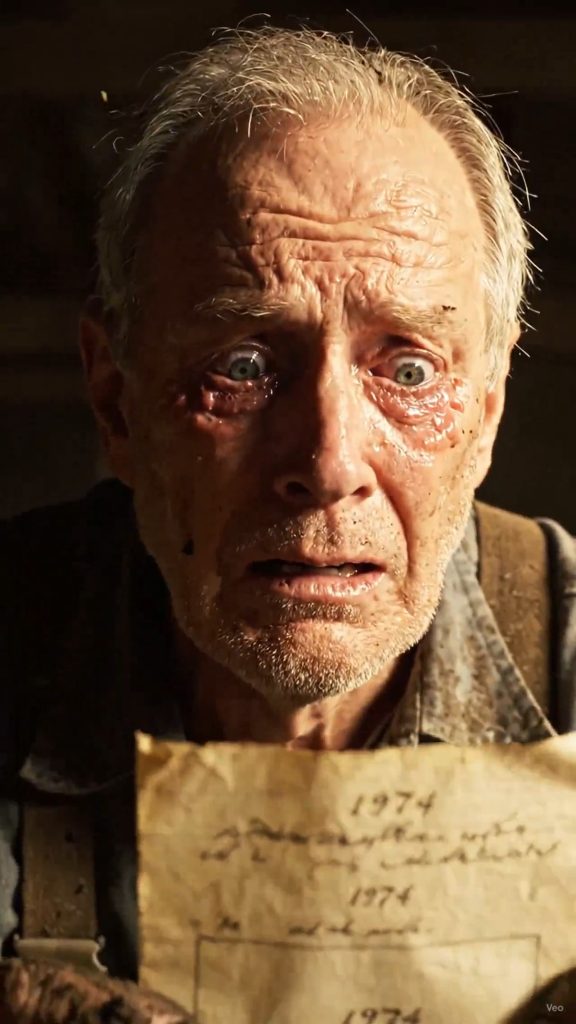
At sixty-eight years old, I took in Major, an eight-year-old retired arson hound left homeless after the county disbanded his unit.



Part 1
Within three days, the dog refused to sleep anywhere except the far corner of my decaying dirt-floor work shed.
When I grabbed a shovel and dug eighteen inches down where Major kept whining, I pulled up a rusted military ammo box wrapped in oilcloth.
Inside was an unmailed letter written in 1974 by my birth mother, revealing that the fire which killed her and my two brothers was no accident.
It was set by the very man who adopted me three weeks later and raised me as his own son: my father, George Higgins.
Major, a Belgian Malinois cross whose muzzle was already turning silver, pawed once more at the packed earth. The sound was a soft, rhythmic scrape against the red clay of the shed floor.
He looked up at me with those deep, intelligent eyes, a low whine rumbling in his chest.
For three days, he’d done little else.
He’d ignored the old cot I’d set up, the dog bed in the corner, even the blanket by the wood stove. His entire world was this one specific spot, exactly two feet from the shed’s north wall, just shy of the doorframe.
“Alright, Major, alright,” I muttered, my voice rough from disuse. I lived alone, and talking to the dog was becoming a habit. “What is it you think you found, boy?”
I picked up the old, splintered shovel leaning against a stack of firewood. The shed was a mess of forgotten tools, rusting parts, and bags of potting soil. It smelled of damp earth and creosote.
Major backed up just enough to give me room, his tail giving a single, hopeful thump against the ground. He watched me intently, his whole body tensed, awaiting my move.
I plunged the shovel blade into the spot he’d indicated. The dirt was stubbornly hard, compacted over decades.
I dug.
The first six inches were tough, full of small roots and pebbles. My back, usually solid from years of volunteer firefighting, twinged. But Major didn’t budge, his gaze fixed on the hole, his nose occasionally twitching.
Another foot down, the clay turned wetter, a rich, iron-red that stained the shovel. The air in the shed was cool, but a bead of sweat trickled down my temple.
Then, the shovel struck something solid. A dull, metallic clunk echoed in the small space.
Major let out a sharp bark, a sound I hadn’t heard from him yet. It was an excited, almost triumphant noise.
I knelt, tossing the shovel aside, and began scraping away the dirt with my hands. My fingers met a rough, oilcloth-wrapped object. It was cold and damp.
Carefully, I pulled it free from the clinging clay. It was a metal box, oblong and heavy, the kind the military used for ammunition. The oilcloth, though grimy, had protected it remarkably well from the damp earth.
Rust covered most of the lid, but the clasps, though stiff, still worked. I flicked them open with a grunt of effort.
Inside, nestled amongst faded, brittle newspaper clippings and a few old, rusted coins, was an envelope. It was thick, yellowed with age, and felt surprisingly intact.
My name, ‘Arthur Higgins,’ was scrawled on the front in a familiar, looping hand that made my breath catch. Below it, in smaller script, was ‘To be opened only if I cannot deliver it myself. October 14, 1974.’
My mother, Martha Higgins. My birth mother.
The date punched me in the gut. October 14, 1974. That was the exact day of the fire. The fire that killed her.
I swallowed hard, my fingers trembling slightly as I tore open the seal. The paper inside was thin, almost translucent, but the ink was still legible, if faded.
Her handwriting. I hadn’t seen it in fifty-six years.
*My Dearest Arthur,*
*If you are reading this, then I was not strong enough. The men came today, Arthur. Not good men. Men who want our land. They spoke of an offer, a big one, but I refused. Our timberland, our home, it’s all we have left. Your father, bless his soul, always said to hold on to it.*
My eyes scanned ahead, skipping over her loving words, drawn to the urgent, desperate tone that began to build in her sentences.
*They threatened me. Said they’d take it another way. I tried to tell you, my little firecracker, but you were only twelve. What could you do? What could anyone do against men like that? I’m so afraid. They said if I didn’t sign, they would make it look like an accident. They said no one would question it.*
A cold dread seeped into my bones, a chill far deeper than the shed’s damp air.
*I have seen them with him. With George. He spoke to them about what they would do. I overheard him.*
George. George Higgins. My adoptive father.
The name jumped out at me, stark and terrifying, illuminated by the dusty beam of sunlight piercing the shed window. I read the next words, my vision blurring, my heart hammering against my ribs.
*He planned it. He will make it look like an accident. Our fire, my son, it will not be an accident.*
I finished the letter, my hand dropping to my lap. The paper felt heavy, burning.
My birth mother. My two brothers. All dead in the blaze. And it was no accident.
It was set by the very man who adopted me three weeks later and raised me as his own son: my father, George Higgins.
Part 2
My hand, still clutching the faded letter, dropped to my lap. The words swirled in my head: *He planned it. He will make it look like an accident.* George. My father. The man who taught me how to tie my shoes, how to throw a baseball. The man who put a roof over my head.
Major nudged my arm, a soft whine escaping him. He looked from my face to the ammo box, then back, as if waiting for me to connect the final dots.
I stood up, the shed suddenly feeling too small, too cold. My mother’s desperate plea echoed across fifty years. This wasn’t just a betrayal; it was a carefully plotted theft.
It had to be about the land. She mentioned their timberland, how George always said to hold onto it. But she also said they wanted their land, not *his* land. *Our* land.
I grabbed the car keys off the workbench. Major followed me out, his gait stiff, but his loyalty unwavering. We drove straight to the Oconee County Courthouse.
The clerk behind the dusty counter, a woman named Carol I vaguely remembered from years ago, looked up from her computer. “Can I help you, Arthur?”
“I need to see some old land deeds, Carol. From 1974. Specifically for the old Higgins timber property, 120 acres, near Pine Creek.”
She nodded, her fingers clicking on the keyboard. A few minutes later, she slid a stack of microfiche over. “Here you go. It’s all on there.”
I spent an hour at the viewer, squinting at the flickering screen, sifting through transactions. My eyes finally landed on it. A transfer deed.
Date: October 11, 1974. Three days before the fire.
Seller: Martha Higgins, my mother. Buyer: George Higgins.
The sale price: $185,000. For the full 120 acres of timberland.
And right there, plain as day, was a clause. My mother’s signature, followed by a hastily scrawled notation: “Guardianship Release for Minor Child, Arthur Higgins, age 12, signed by Martha Higgins.”
He didn’t just buy the land. He forged her name on a legal document giving him control over *me* and my inheritance rights to that land, all three days before he burned her out of it.
I pushed away from the viewer, the chair scraping loudly across the linoleum. My hands were shaking, not from anger, but from a profound, sickening hollowness. My entire life, my entire upbringing, was a lie built on this paper.
The drive home was a blur. The familiar roads, the trees, the small town businesses, all seemed distorted. Major sat silently in the passenger seat, his head resting on the dash.
As I pulled into my gravel driveway, I saw a figure standing on my porch.
Marcus Brody. Town Councilman Marcus Brody, adjusting his tie, a folded document clutched in his hand.
More Stories





+ There are no comments
Add yours